What Is a Ghost MOT? How to Spot One Before You Buy
- 19 Oct 2026
- in Car Servicing
- by Michael Rochford
What is a Ghost MOT?
A ghost MOT is an MOT pass that has been officially recorded on the DVSA database for a vehicle that was never actually tested. The certificate is real and the record is real, but nobody ever checked the brakes, tyres, steering or emissions.
No, it’s not a haunted inspection pit. It’s a pass that exists on paper and online while the car itself never went near the testing bay. That’s what makes ghost MOTs so tricky: everything looks legitimate until something on the car fails on the road.
If you’re buying a used car, a ghost MOT means the safety record you’re relying on could be fiction. Here’s how they happen, how common they are, and the warning signs to look for before you hand over any money.
How common are ghost MOTs?

Ghost MOTs are rare compared with the millions of honest tests carried out every year, but they’re rising fast. DVSA figures obtained through a Freedom of Information request show 1,809 vehicles were found with fraudulent MOTs in 2024, up from 976 the year before Driver and Vehicle Standards Agency August, 2025).
That’s an 85% rise in a single year, and some areas saw much sharper jumps. In Kent, cases went from just three in 2023 to 74 in 2024 (same source). For context, the Driver and Vehicle Standards Agency (DVSA) tests over 32 million vehicles a year, and only 2% of road incidents are caused by mechanical failings (Driver and Vehicle Standards Agency, August ,2025). Every ghost MOT chips away at that.
Ghost MOTs are also the most common type of MOT fraud by a distance. According to the DVSA, they account for nearly 80% of all fraudulent MOTs (Driver and Vehicle Standards Agency, February, 2025).
The real number is likely higher. Within the motor trade there is consensus that the official figures barely scratch the surface, because a ghost MOT is hard to spot once it’s on the system. One single tester was found to have issued 233 of them (The Guardian, April, 2026).
Why do people get ghost MOTs?
Most ghost MOTs come down to money. A car that would fail its MOT might need hundreds of pounds of repairs, and paying a rogue tester to record a pass is cheaper and less hassle.
Increasingly, the deal is done online. Buyers are invited into private Telegram or WhatsApp chats, send their car’s details and a fee, and receive a legitimate-looking certificate by email. Owners of heavily modified cars are another common customer, wanting paperwork that holds up if they’re stopped by police.
It’s not a victimless shortcut. A car with no real MOT could have faulty brakes, worn tyres or failing steering. The driver may have chosen that risk, but the people in the car they hit didn’t.
Ghost MOT vs fake MOT certificate: what’s the difference?
A ghost MOT is a real pass on the official record, while a fake MOT certificate is a forged piece of paper that isn’t on the record at all. They’re often confused, but you check for them in different ways.
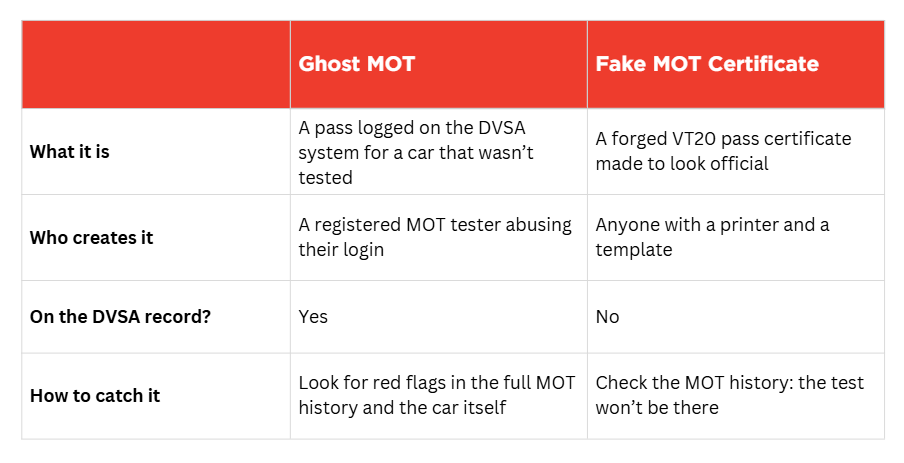
Forged paper certificates are easy to make because, outside Northern Ireland, MOTs are carried out by thousands of independent garages rather than government test centres. Check the official record, and if the test date or result on the certificate doesn’t appear there, walk away.
How to spot a ghost MOT on a used car
You can’t prove a ghost MOT from the record alone, because the record looks genuine. What you can do is look for patterns that don’t add up. Start with a MotorCheck car registration check to see the car’s full MOT history, then compare it against the car in front of you.
- A clean pass after a run of fails. If a car failed on several items, then passed with no advisories shortly after, ask for receipts for the repairs. No paperwork is a warning sign.
- Advisories that vanish. Real cars collect advisories as they age: tyres wearing, minor corrosion, a slight oil leak. If issues listed one year disappear the next with no record of repair, be suspicious.
- A pass that’s too perfect. A car that’s ten years old with no advisories at all is possible, but it’s unusual. If it looks too good to be true, it might be.
- Mileage that doesn’t flow. Mileage should rise steadily at each test. A drop, or a reading that barely moves while the car shows plenty of wear, can point to a fake test or a clocked car.
- A car that doesn’t match its pass. Bald tyres, warning lights on the dash, blown bulbs or a knocking suspension on a car that passed recently is the biggest giveaway of all.
- Missing details. A real MOT records plenty of detail, from headlight aim to engine.
If several of these line up, don’t buy the car until it has had an independent inspection. And always check the history before you hand over a deposit, not after.
Is it illegal to buy a ghost MOT?
Yes. Knowingly paying for an MOT pass on a car that wasn’t tested is fraud, and both the tester and the owner can be prosecuted.
For owners, the risks stack up:
- No valid MOT. A ghost pass isn’t a genuine test, so the car is effectively being driven without one. That can mean a fine of up to £1,000.
- A dangerous vehicle. If the car is in a dangerous condition, the fine rises to up to £2,500, with three penalty points and a possible driving ban.
- Insurance problems. Insurers may refuse to pay out if a car without a genuine MOT is involved in a crash.
For testers and garages, the consequences include suspension or permanent removal from the MOT scheme, and prosecution under the Fraud Act 2006, which carries a maximum sentence of 10 years in prison.
If you bought a car without knowing it had a ghost MOT, you haven’t committed fraud. But you’re still responsible for the car being roadworthy, so get it properly tested.
What is the DVSA doing to stop ghost MOTs?
The DVSA is using cameras, data and now photos to prove a car was really at its test. It’s part of a wider tightening of the rules in 2026, which we cover in our guide to the new MOT rules.
- ANPR cameras. Automatic Number Plate Recognition can show whether a car was anywhere near the test centre on the day it supposedly passed.
- Data analysis and AI. The DVSA uses AI to flag suspicious activity on the MOT Testing Service, such as several tests completed in unrealistically short periods, which its intelligence team then investigates.
- Photos at test. From 3 August 2026, testers at around 2,500 garages in Great Britain can take and upload a photo of the vehicle during the test, as evidence it was physically there. The photo is optional for now, and more garages will get the feature later (Driver and Vehicle Standards Agency, July, 2026).

The crackdown is producing results. In January 2026, MOT tester Owain Shaw and mechanic Jamie Lee were sentenced at Bristol Crown Court after recording passes for 223 vehicles that were never tested at Staple Hill Motoring Centre. Investigators monitoring the system from outside the centre saw Shaw issue a certificate in under one minute for a car that wasn’t there. Bank records showed Lee had paid Shaw £11,428, disguised as payments for “car parts”. That works out at roughly £51 per car, about the price of a genuine MOT. Shaw received a two-year suspended sentence and 300 hours of unpaid work, and Lee a two-year suspended sentence and 250 hours (Driver and Vehicle Standards Agency, February, 2026).
Smaller cases end up in court too. Neil Gabbott at Swansey MOT Centre in Chorley issued 10 fake certificates for cars from Scotland to Southampton. The testing station was shut down within 24 hours, and Gabbott was given a 12-month community order with 200 hours of unpaid work, £2,000 in costs and a £114 victim surcharge (Driver and Vehicle Standards Agency, August, 2025).
Prosecutions have nearly doubled in three years, from 18 in 2022 to 2023 to 35 in 2025 to 2026. In 2025 to 2026 alone, the DVSA also issued 173 cessations stopping MOT garages from testing, 98 of them for serious breaches such as dishonesty (Driver and Vehicle Standards Agency, September, 2026).
Other types of MOT fraud: the fake fail
Not all MOT fraud is about passing a car that should fail. The reverse also happens: a garage invents problems with a healthy car, then quotes for quick fixes “just to get it through”. The owner pays for repairs the car never needed.
If a fail seems surprising, ask to see the faults for yourself, compare the result with the car’s previous MOT history, and get a second opinion before paying for major work.
What to do if you think your car has a ghost MOT
Report it to the DVSA, and get the car properly tested at a DVSA-approved centre before you drive it any further. You can report an MOT tester or centre on GOV.UK, and you don’t have to give your own details.
The more information you can share, the better:
- the car’s registration and the MOT certificate
- the seller, whether a dealer or private seller
- the MOT test centre that issued the pass
- the dates of the sale and the test
It’s also worth knowing that a ghost MOT can be cancelled after you’ve bought the car. When the DVSA catches a fraudulent tester, it cancels the certificates they issued and contacts the owners. In the Bristol case, all 223 certificates were cancelled, leaving those owners needing a genuine test.
The DVSA’s crackdown is making ghost MOTs harder to pull off, but they haven’t gone away. Before you buy any used car in the UK, run a MotorCheck car history check and look at the full story behind the pass.
 by