Used car buyers have always had a simple rule of thumb: check the mileage. Fewer miles on the clock means less wear, a more desirable car, and a safer purchase. That rule is becoming obsolete.
As the used electric vehicle market grows rapidly in the UK, mileage alone no longer tells the full story. The number that really matters is the battery's State of Health, or SOH. It determines how much range you will actually get and what the car is genuinely worth, yet unlike a mileage reading, it is not displayed on the dashboard. You have to know to ask for it.
This guide explains EV battery degradation: what it is, why it matters financially, what causes it to happen faster than it should, and most importantly exactly what you can do to protect yourself, whether you already own an EV or are about to buy one.
What is Battery State of Health (SOH)?
State of Health is the single most important figure when assessing any EV battery. It measures how much of the battery’s original charging capacity remains, expressed as a percentage.
A brand-new battery has an SOH of 100%. As it is used, charged, and discharged over time, that figure gradually falls. The industry’s accepted threshold is 70% SOH: below this point, the battery is considered unsuitable for continued use in a vehicle, and all major manufacturers’ battery warranties will trigger a free replacement at this level.
Batteries below 70% SOH are not worthless. They can live on as home energy storage units, the kind that store solar power, or be recycled into new cells.
Think of SOH like tyre tread depth: invisible at a glance, declining gradually with use, and crossing the critical threshold has immediate practical and financial consequences.
Why EV Battery Degradation Matters: The Financial Stakes
Battery degradation is the gradual loss of a battery's ability to hold a full charge. Every lithium-ion battery degrades over time, just as engine and gearbox components eventually wear out. What makes it a bigger concern in an electric car is the potential cost when it goes too far.
Replacing an EV battery is not like replacing a clutch or a set of brake pads. Depending on the vehicle, a full battery replacement can cost anywhere from £6,000 to over £20,000. These figures can instantly wipe out any saving made on the purchase price of a used car.
The impact on range is equally significant. A car with a claimed range of 300 miles, once its battery has degraded to 70% of its original capacity, will only deliver around 210 miles per charge. That is the threshold at which most manufacturer warranties trigger a replacement, and for good reason: a 90-mile reduction in range fundamentally changes how useful a car is in everyday life.
The critical point is this: unlike a worn tyre or a noisy engine, battery degradation is largely invisible to used car buyers. A used EV can look immaculate, have a full service history, and still have a battery that has lost 25% or more of its original capacity, with nothing on the car to tell you so.
A missing or unavailable battery SOH report when buying a used EV should be treated as a serious red flag. It is a walk-away moment.
How Fast Does EV Battery Degradation Happen and What Causes It?
Modern EV batteries have proven far more durable than the early sceptics predicted. Real-world data from Geotab, which monitors large commercial EV fleets, shows average degradation of around 2.3% per year meaning most batteries retain well over 70% SOH for more than a decade.
To put that in practical terms for real models:
- A Renault 5 E-Tech 52kWh with a claimed range of 254 miles loses around 5.8 miles of range per year at the average degradation rate.
- A 77kWh Volkswagen ID.4 with a range of 350 miles loses around 8.0 miles of range per year at the same rate.
But averages mask significant variation. The single biggest driver of accelerated degradation is how, and how often, the battery is charged. The difference between charging behaviours is more significant than most buyers realise. A driver who relies heavily on public rapid chargers could see their battery degrade twice as fast as someone who charges at home every night.
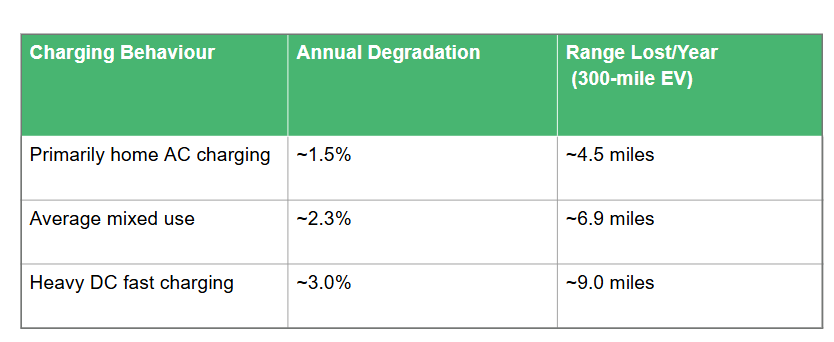
Source: Geotab EV Battery Degradation Report, 2025.
Geotab’s 2025 figure of 2.3% is already higher than its 2024 figure of 1.8%, a rise the company attributes directly to growing reliance on DC fast chargers. As more drivers use public rapid charging networks rather than charging at home, the fleet-wide average is edging upward.
Beyond charging behaviour, other factors that accelerate degradation include: frequent exposure to extreme heat, regularly leaving the battery near 100% charge for extended periods, and to a lesser extent very cold temperatures.
How Long Do Electric Car Batteries Really Last?
The most rigorous real-world test of EV battery life to date was conducted by ADAC, Germany’s equivalent of the AA over four years and 172,000km (107,000 miles) in a standard VW ID.3. The test was designed to reflect hard, everyday use rather than controlled laboratory conditions:
- DC fast charging was used for approximately 40% of all charging sessions.
- The battery was regularly charged to 100% and left connected after reaching full capacity.
- The car was driven at sustained high speeds on the Autobahn, in extreme cold, and in Alpine conditions.
The result: after 172,000km, the battery had lost just 9% of its original capacity, retaining 91% SOH, independently confirmed by battery testing specialists Aviloo.
Given the ID.3's claimed WLTP range of 557km (346 miles), the car could still cover approximately 315 miles per charge after 107,000 miles of frequent fast charging, extreme temperatures and sustained motorway speeds.
Part of this resilience comes from a built-in buffer. Manufacturers deliberately reserve 5–7kWh of battery capacity beyond the quoted figure, and as the battery ages they can quietly unlock more of it via software updates, compensating for natural degradation without the driver noticing.
Electric car battery life expectancy is not the liability it once appeared. But not all batteries are equal. How a car has been driven and charged makes a real difference, and you need the right checks to tell them apart.
How to Protect Yourself Against EV Battery Degradation
Protection falls into two categories: the steps you take before buying a used EV, and the habits you adopt as an owner. Both are important.
Buying a Used Electric Car: Five Steps to Protect Yourself
Step 1: Run a MotorCheck vehicle history report
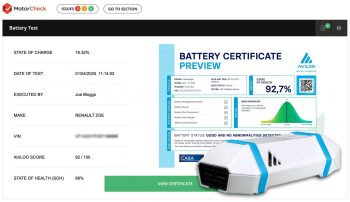
Before you look at anything else, run a MotorCheck vehicle history report . It gives you independent, verified data on any used EV you are considering, including battery State of Health data where available, without relying on information provided by the seller.
As well as battery health, a MotorCheck vehicle report covers outstanding finance, write-off status, mileage verification, stolen vehicle checks, and previous keeper history. In a market where a degraded battery can cost thousands to replace and its condition is invisible to the eye, a MotorCheck report is an effective step to take before any used EV purchase.
Step 2: Always insist on a written battery SOH report
Any reputable dealer should provide a battery State of Health report alongside the standard service history. The report will show the battery’s current capacity as a percentage of its original specification, giving you a clear picture of how much range to expect and how much degradation has already occurred.
SOH reports are generated by tools including Aviloo, Battery Passport, and manufacturer diagnostic systems. If a seller cannot or will not provide one, treat it as a serious warning sign and consider walking away.
Step 3: Prioritise cars still within their manufacturer battery warranty
All new EVs sold in the UK come with a dedicated battery warranty, separate from the standard vehicle warranty, and under UK consumer law this warranty transfers fully to subsequent owners. Most manufacturers offer eight years or 100,000 miles as standard, though Toyota extends this to ten years for cars serviced at a main dealer, and BYD covers up to 150,000 miles. All set the same SOH threshold: if the battery drops below 70% of its original capacity within the warranty period, the manufacturer is obligated to replace it at no cost to you.
That makes warranty status one of the most practical things to check when buying used. Given that most EVs sold in the UK from around 2017 onwards carry this cover, there is a growing pool of used electric cars with substantial warranty remaining and that remaining cover transfers to you as the new owner.
Step 4: Check the charging history
Charging history for an EV is the equivalent of service history for a petrol car. A car primarily charged at home on a slow AC wall box will typically have significantly better battery health than one that has relied on public rapid chargers. Many EVs and their companion apps retain a charging history log. Ask to see it, or have the car connected to a diagnostic tool.
Step 5: Do not rely on mileage alone
A low-mileage EV that has been regularly fast-charged may have worse battery health than a higher-mileage car that charged at home every night. SOH is the definitive metric. Mileage is context, not the whole picture.
Owning an Electric Car: Five Habits to Slow Degradation
1. Charge at home on a slow AC charger wherever possible
This is the single most impactful daily habit for long battery life. Home charging on a 7kW wallbox produces approximately half the degradation of heavy DC fast-charging. Geotab’s data shows that drivers who primarily charge at home see degradation of only ~1.5% per year, versus up to 3.0% for heavy fast-charger users.
2. Set your daily charge limit to 80%
Most EVs allow you to cap charging at 80% via the car's settings or app, and as a daily habit this reduces long-term stress on the battery cells. Override it to 100% when you need the full range for a longer journey. As ADAC's endurance test demonstrated, occasional full charges cause no lasting damage.
3. Pre-condition your car while it is still plugged in
Most EV owners overlook pre-conditioning, yet it is one of the simplest and most effective ways to protect battery health. The principle is straightforward: use your car's app to heat or cool the cabin before you set off, while the car is still plugged in and drawing from the grid rather than the battery.
The reason it matters is that running the heater or air conditioning while driving is one of the heaviest drains on range, costing an estimated 6–7 miles for every hour in use. Pre-conditioning eliminates most of that cost before you have even left the driveway.
4. Avoid leaving the battery at 100% for extended periods
Where possible, time your charging to finish close to when you plan to drive. Keeping a lithium-ion battery at maximum charge for prolonged periods such as charging to 100% on Friday evening and not driving until Monday adds chemical stress over time.
5. Protect the battery from extreme heat
Sustained heat is harder on lithium-ion batteries than cold. Avoid parking in direct sunlight for extended periods in hot weather. Cold weather temporarily reduces range but causes less long-term damage than heat exposure.
Not sure what your battery’s current State of Health actually is? A MotorCheck vehicle history report includes battery SOH data where available, giving you an independent baseline whether you are checking a car you already own or one you are considering buying.
Check EV Battery Health Before You Buy with MotorCheck
Buying a used car always carries risk. A vehicle history check is how you manage it. For used electric vehicles, that protection now extends to the battery itself.
A MotorCheck vehicle history report gives used EV buyers in the UK a comprehensive picture of any car they are considering, covering outstanding finance, write-off status, mileage discrepancies, stolen vehicle records and previous keeper history, as well as battery State of Health data where available.
That matters because the battery is the most expensive component in any electric car, and unlike a worn tyre or a rattling engine, its condition gives nothing away. A used EV can look great, drive well, and still be quietly heading towards a repair bill that runs into thousands. The information in a MotorCheck report comes directly from the vehicle's history, not from the seller. It cannot be altered, and it tells the true story of how a battery has been treated throughout its life.
Frequently Asked Questions: EV Battery Degradation and Electric Car Battery Life
How long do electric car batteries last?
Most EV batteries last between 10 and 20 years, or 100,000–200,000 miles. Geotab fleet data shows average degradation of around 2.3% per year, meaning most batteries comfortably retain over 70% capacity the warranty replacement threshold, for well over a decade.
What is the life expectancy of an electric car battery?
The typical life expectancy of an electric car battery is 10–20 years. All new EVs sold in the UK include an 8-year/100,000-mile battery warranty as standard, and real-world data consistently shows batteries outliving those benchmarks.
How many miles does an electric car battery last?
Electric car batteries routinely last 100,000–200,000 miles. ADAC’s real-world endurance test saw a VW ID.3 retain 91% of original capacity after 172,000km (107,000 miles) of hard, fast-charge-heavy driving.
How fast does an EV battery degrade?
On average, EV batteries degrade at around 2.3% per year (Geotab, 2025). Home AC charging keeps this as low as 1.5% per year, while heavy reliance on DC fast chargers can push it to 3.0% per year.
Does charging to 100% damage an EV battery?
It can accelerate degradation slightly, but the impact is modest in practice. ADAC’s four-year, 172,000km test which regularly charged to 100%, still showed only 9% total battery loss, well within acceptable limits.
What is a good State of Health for a used EV battery?
Anything above 80% SOH is considered good for a used EV. The critical threshold is 70%: below this, most manufacturer warranties obligate a free battery replacement. Always insist on a written SOH report before buying any used electric car.
Does fast charging shorten battery life?
Yes. Heavy use of DC fast chargers is the single biggest factor in accelerated EV battery degradation. Geotab data links fast-charging-heavy use to up to 3% degradation per year, versus ~1.5% for drivers who mainly charge at home.
How can I make my EV battery last longer?
Charge primarily at home on a slow AC charger, avoid leaving the battery at 100% for extended periods, use pre-conditioning via your car’s app to heat or cool the cabin while plugged in, and minimise exposure to extreme temperatures.
Can you buy a used EV with a battery warranty?
Yes and ideally you should. If the car is still within its original 8-year/100,000-mile window, the manufacturer’s battery warranty transfers to you. This is one of the most important checks when buying a used electric vehicle in the UK.
What happens to an EV battery at end of life?
End-of-life EV batteries can be repurposed as static energy storage units (‘second-life’ batteries), or fully recycled into new battery cells. This circularity is an environmental advantage that combustion vehicles cannot match.
Does a MotorCheck report show EV battery health?
Yes. A MotorCheck vehicle history report includes battery State of Health data where available, giving used EV buyers a clear, independently verified picture of a battery’s condition before they commit to a purchase.
 by
by