- The new pay-per-mile car tax, starts on 1st April 2028.
- Fully electric and hydrogen cars pay 3p a mile. Plug-in hybrids pay 1.5p a mile.
- It is charged on top of standard road tax, not instead of it.
- You report your own mileage. There are no trackers and no location data.
- Rates rise with inflation from 2029-30.
- Pre-paid miles stay with the car when you sell it, which puts a cash value on every mile showing on the odometer.
What is pay-per-mile car tax?
Pay-per-mile car tax is a mileage-based charge on electric and plug-in hybrid cars. Its official name is Electric Vehicle Excise Duty, or eVED. Instead of paying a flat annual fee alone, drivers of these cars will also pay for each mile they cover.
It was announced at Budget 2025. The government consulted on how it would work between 26th November 2025 and 18th March 2026, received 5,133 responses, and published its response on eVED on 13th July 2026. The rates, the start date and the way mileage will be reported are now confirmed.

When does pay-per-mile car tax start?
eVED takes effect on 1st April 2028. You will pay it the first time you renew your vehicle tax after that date. The DVLA will administer it, in the same way it administers road tax now. The measure is expected to affect around 5.6 million vehicles in its first year.
One caveat worth knowing. eVED still needs its own legislation, and that has not yet been introduced. The rates and the design are confirmed government policy, but nothing is on the statute book until a Finance Bill carries it there, so details can still change before 2028.
How much will pay-per-mile car tax cost?
The rate is 3p a mile for fully electric and hydrogen fuel cell cars, and 1.5p a mile for plug-in hybrids. What you actually pay depends entirely on how far you drive.
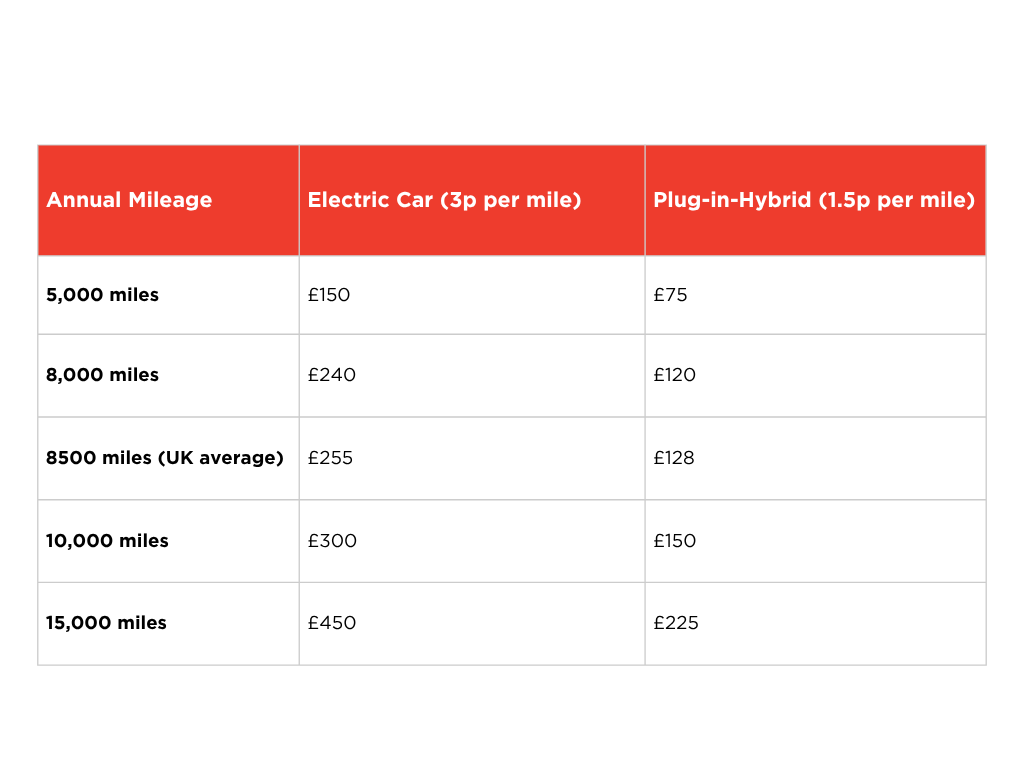
The Office for Budget Responsibility puts the typical bill at around £255 a year for a driver covering 8,500 miles. That sits on top of the standard rate of road tax, which electric car drivers have paid since April 2025 and which is £200 in 2026-27. On today’s rates, that puts the total annual motoring tax bill for an average electric car driver at roughly £455 from 2028-29.
From 2029-30 the rates will rise each year in line with CPI inflation, so the charge holds its value in real terms. That matters more than the headline figure. A tax that tracks inflation from the start will look very different by the mid-2030s.
Will eVED replace road tax?
No. eVED is an extension of the existing road tax system, not a replacement for it. You will pay your standard Vehicle Excise Duty exactly as you do now, and the mileage charge will be added on top. The two are collected together when you renew.
Which vehicles have to pay eVED?
In scope from April 2028:
- Battery electric cars, at 3p a mile
- Hydrogen fuel cell cars, at 3p a mile
- Plug-in hybrid cars, at 1.5p a mile
Out of scope at launch:
- Self-charging hybrids, which run mainly on petrol and already pay fuel duty
- Electric vans, buses, coaches and HGVs, where the switch to electric is less advanced than it is for cars
Why is pay-per-mile tax being introduced?
Fuel duty. The government currently takes 52.95p in duty on every litre of petrol and diesel, plus 20% VAT on top of that, raising roughly £25 billion a year. Electric cars pay none of it.
That rate has barely moved since 2011. Budget 2025 set out a staged reversal of the temporary 5p cut, starting in September 2026, but in May 2026 the Prime Minister postponed it. Duty stays at 52.95p until the end of 2026, and what happens after that is expected to be settled at the Autumn Budget.
As more drivers switch, that revenue falls away, and the OBR expects the decline to continue. eVED is the replacement. The rate has been set at about half what the average petrol or diesel driver pays in fuel duty, and the Treasury expects it to raise £1.1 billion in 2028-29, rising to £1.9 billion by 2030-31.
Are electric cars still cheaper to run?
Yes, for most drivers. A petrol car costs somewhere between 15p and 17p a mile in fuel alone, depending on economy and pump prices. An electric car charged mostly at home costs around 5p a mile once eVED is included. The gap narrows. It does not close.
The government has also put a £3.6 billion support package behind electric car ownership, and raised the threshold at which the expensive car supplement starts to apply to zero emission cars from £40,000 to £50,000.
The argument in the industry is about timing rather than principle. From 2028, an electric or plug-in hybrid driver could pay more in annual car tax than someone running a petrol or diesel car, at a point when the switch to electric is still fragile. Mike Hawes, chief executive of the Society of Motor Manufacturers and Traders, responding to the Autumn Budget on 26 November 2025, called eVED "the wrong measure at the wrong time".
The government’s official finance watchdog, the Office for Budget Responsibility (OBR) shares some of that concern. It estimates that eVED and the measures introduced alongside it will reduce electric car sales by around 120,000 by 2030-31, which is roughly 2% of expected sales over that period.
How will your mileage be checked?
You report it yourself. When you renew your vehicle tax you give a current odometer reading and estimate the miles you expect to drive in the year ahead. You can pay the whole amount upfront or spread it across the year, and top up mid-year if you find you are driving more than you planned.
At the end of the period you submit an actual reading and the DVLA reconciles the two. Drive more than you estimated and you pay the difference. Drive less and you carry a credit into the following year.
The DVLA will cross-check your figures against the mileage recorded at your MOT, which is already collected and already published on GOV.UK. For most cars that means no extra steps and no additional appointments.
One change is worth knowing about. The original proposal would have required extra mileage checks on cars under three years old, which are too new to need an MOT. After the consultation, the government dropped it. Cars under three, or under four in Northern Ireland, will not face routine mileage checks.
What about privacy?
Early versions of pay-per-mile taxation involved GPS trackers and real-time monitoring. That would have allowed peak and off-peak pricing, which would have benefited some drivers, but it would also have told the government where every car was at any given moment. It has been ruled out.
eVED records how far a car has travelled, not where, when or how. No tracker will be fitted to anyone’s car and no location data will be collected.
The July response did confirm one addition. Drivers of cars with built-in 4G or 5G connectivity, which covers most cars sold since 2018, will be able to opt in to sending their mileage automatically rather than reading it off the dashboard. It is a convenience option, not a requirement, and opting in shares distance only.
Does eVED make car clocking more likely?

Yes, and this deserves more attention than it is getting.
Clocking a modern digital odometer is still straightforward. FleetCheck, which supplies systems for running large company car fleets, has warned that even with digital instruments, rolling mileage back is easy and very hard for the authorities to spot between MOT visits.
Now add two things. Mileage has a precise, published cash value of 3p a mile. And cars under three years old will not face routine mileage checks, which leaves a three-year window at the start of a car’s life with no independent verification at all.
Rolling back an odometer used to be a gamble on resale value, and a clocked car might still fail to find a buyer. Under eVED it also reduces a tax bill. That turns mileage from a consumer protection problem into a fiscal one, and the unintended consequences could run a long way.
What happens to your eVED when you sell the car?
This is where eVED changes the used car market.
Pre-paid mileage belongs to the vehicle, not to the owner. If you pay for 10,000 miles, drive 7,000 and then sell, the remaining 3,000 miles transfer to the new keeper. The DVLA plans to make a car’s eVED position visible online, and the government expects the value of any pre-paid mileage to be reflected in the sale price.
In practice, used listings will start to read something like: one owner, full service history, 3,000 eVED miles remaining this year.
Not everyone is convinced this will work cleanly. Which? has described the assumption that pre-paid mileage will be properly reflected in sale prices as unevidenced and broad-brush. If a seller does not account for it, or a buyer does not know to ask, the money quietly disappears.
What this means if you are buying a used electric car
From 2028, the odometer reading on a used electric car tells you three things at once: how much life the car has left in it, what it is worth, and what its tax position is. Buy a car with a rolled-back odometer and you are not only overpaying. You may also be taking on an inaccurate eVED record.
Before you buy, check:
- Whether the mileage history shows any discrepancies
- Whether the eVED position matches what the seller has told you
- Whether the readings line up across MOT records, service records and dealer records
How to protect yourself: check the mileage history
The answer to clocking is data. Detecting it is difficult, but it is exactly what we do.
MotorCheck holds data from over 500 million odometer readings, drawn from trusted UK sources including the DVLA, MOT test centres and dealership records. That does not mean every case of clocking can be caught, but it lets us build a pattern of use for each car. When a vehicle’s average annual mileage suddenly drops, that is a signal worth investigating.
From April 2028, running a vehicle history check before you buy will not just be a matter of consumer protection. It could materially affect your tax bill too.
Run a MotorCheck car history check before you buy.
All policy figures were verified against the government consultation response of 13 July 2026, the House of Commons Library briefing, the OBR and HMRC.
 by
by