Quick Answer: To check if a car has been written off in the UK, run a vehicle history check using the registration number, which searches the Motor Insurer Anti-Fraud and Theft Register (MIAFTR) for a write-off marker and its category. You can check any UK registered car this way, whether you are buying it or you already own it. A free DVLA vehicle enquiry shows tax and MOT details but does not reveal write-off status, so a full history check is the only reliable way to confirm it. UK insurers use four categories: Cat A and Cat B must never return to the road, while Cat S and Cat N can be repaired and driven again.
Whether you are about to buy a used car or you want to check your own, finding out if it has ever been written off matters. A vehicle that was declared a total loss, repaired, and put back on the road can look perfectly normal while hiding a serious accident in its past.
More than 500,000 vehicles are written off in the UK every year, and a large share are repaired and returned to the road. Some are then sold on without the write-off ever being disclosed.
This guide explains how to check if a car has been written off, what the categories mean, what happens when a car is written off, and whether a write-off is safe to buy.
How do you check if a car has been written off?
The most reliable way to check if a car has been written off is to run a vehicle history check using the registration number. This searches insurer records held on the Motor Insurer Anti-Fraud and Theft Register (MIAFTR) for a write-off marker and its category, and it works for any UK registered car, including your own.
A MotorCheck report searches for any record of the vehicle being previously written off in the UK, covering Category A, B, C, D, S, N and Y, with the data sourced from the MIAFTR. It also checks for vehicles recorded as scrapped with the DVLA or that have had a VIC test.
Insurers are required to record total-loss vehicles, so most genuine write-offs from recent years appear on these databases. A small number may not, for example where a vehicle was self-insured, uninsured, or the owner never made a claim, which is why it is wise to combine the check with a careful inspection.
Can you check if a car is a write-off for free?
There is no genuinely free way to confirm a write-off. A free DVLA vehicle enquiry on gov.uk shows a car's tax and MOT status, but it does not reveal whether the vehicle has ever been written off.
Only a full vehicle history check searches insurer databases for a write-off marker and its category. Free checks are still a useful first step: the free MOT history can show advisories or repairs that hint at past accident damage, but it will not confirm a write-off on its own.
What do the UK write-off categories mean?
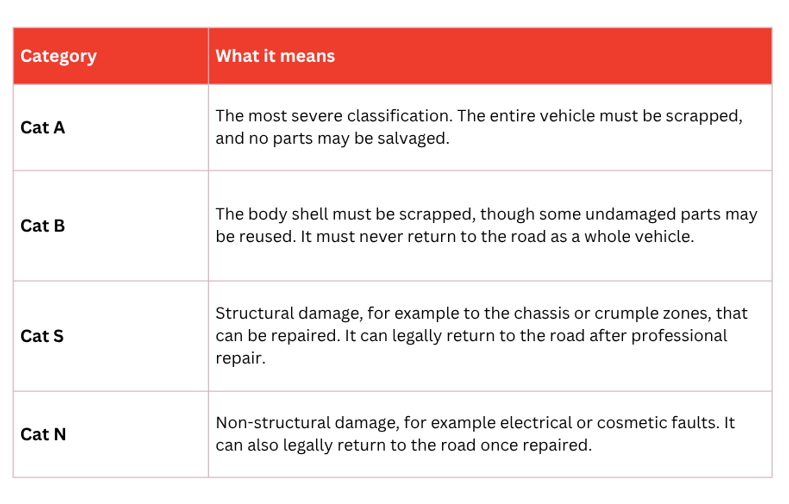
UK insurers assign one of four write-off categories to show how badly a car was damaged and whether it can legally return to the road: Cat A, Cat B, Cat S and Cat N.
Before October 2017 the UK used categories C and D. Cat C is broadly equivalent to today's Cat S, and Cat D to today's Cat N, so you may still see older cars carrying a Cat C or Cat D marker. Treat Cat C like Cat S, and Cat D like Cat N, when you weigh up the risk.
What happens when a car is written off?
When an insurer decides a car is not economical or safe to repair, it declares the car a total loss, or write-off, pays out its pre-accident value, and takes ownership of the vehicle. The car is then given a category and recorded on insurer databases.
A car is typically written off when the cost of repairs reaches about 50% to 70% of its pre-accident value. If the vehicle is a repairable Cat S or Cat N, it can be repaired and returned to the road, but the write-off marker stays on its history for good.
If your own car has just been written off and you are unsure about your settlement or your cover, speak to your insurer directly, as the exact position depends on your policy.
Is it worth buying a written-off car?
A well-repaired Cat S or Cat N car can offer good value and often sells for noticeably less than an equivalent car with no history, but it comes with trade-offs you should weigh carefully.
Written-off cars can be harder to insure, some insurers charge more or decline cover, and resale value is lower. There is also the risk of poor repair work, so ask to see any repair invoices and photographs from before and after the work.
- Cat A and Cat B: never buy for road use, without exception.
- Cat S: potentially viable if repairs have been independently verified. Arrange a specialist inspection and negotiate a meaningful discount.
- Cat N: often the lowest risk, but still confirm the damage and the quality of any repair before you buy.
Check any car's write-off history with confidence
A write-off is not always a reason to walk away, but it should always be disclosed, priced in, and understood. Failing to declare a write-off when selling is against the law in the UK, so a clear history check protects both buyers and honest sellers.
Run a MotorCheck car history check to confirm a vehicle's write-off status and category, whether you are buying a car or checking your own. Every Full Check report for non-trade users carries a data guarantee of up to 30,000 pounds for your protection.
Frequently Asked Questions: Written Off Car
What does it mean when a car is written off?
A write-off is a car that an insurer has decided is uneconomical or unsafe to repair, so it is declared a total loss. The insurer pays out the car's value and records a write-off category against the vehicle.
What is the difference between Cat S and Cat N?
Cat S means the car had structural damage, such as to the chassis, that has since been repaired. Cat N means the damage was non-structural, such as electrical or cosmetic. Both can legally return to the road.
Am I still insured if my car has been written off?
Once your car is written off and your insurer settles the claim, cover for that vehicle normally ends, as the insurer takes ownership. The exact position depends on your policy, so check the details with your own insurer.
Can an insurance company write off my car without inspecting it?
Yes. An insurer can assess a vehicle as a total loss using photographs, repair estimates and engineer reports rather than a physical inspection. If you disagree with the decision, you can raise it with your insurer directly.
Does a write-off show up on the MOT history?
No. The free MOT history does not record write-off status, although repeated advisories or failures can sometimes hint at past damage. A full vehicle history check is needed to confirm a write-off.